
Views: 0 Author: Site Editor Publish Time: 2026-10-15 Origin: Site


Disposable ECG electrodes are essential components in electrocardiography, allowing medical professionals to record the electrical activity of the heart through electrodes attached to the skin.
They are commonly used in hospitals, diagnostic centers, emergency departments, and cardiac monitoring applications. Their performance depends on conductive materials, skin adhesion, electrical stability, and compatibility with monitoring equipment.
Understanding the materials, features, and applications of disposable ECG electrodes helps medical device manufacturers and healthcare buyers select suitable electrode products for different clinical requirements.
Table of Contents
Disposable ECG electrodes are single-use sensing electrodes designed to detect electrical signals generated by the heart.
They usually contain a conductive sensing element, an electrolyte gel or hydrogel interface, an adhesive backing, and a connector for attachment to ECG monitoring equipment.
Unlike reusable electrodes, disposable ECG electrodes are intended for one-time use according to their labeling. They eliminate the need to clean and reprocess the electrode between patients.
These electrodes are commonly available in different shapes, sizes, adhesive materials, and connector configurations to accommodate different monitoring procedures.
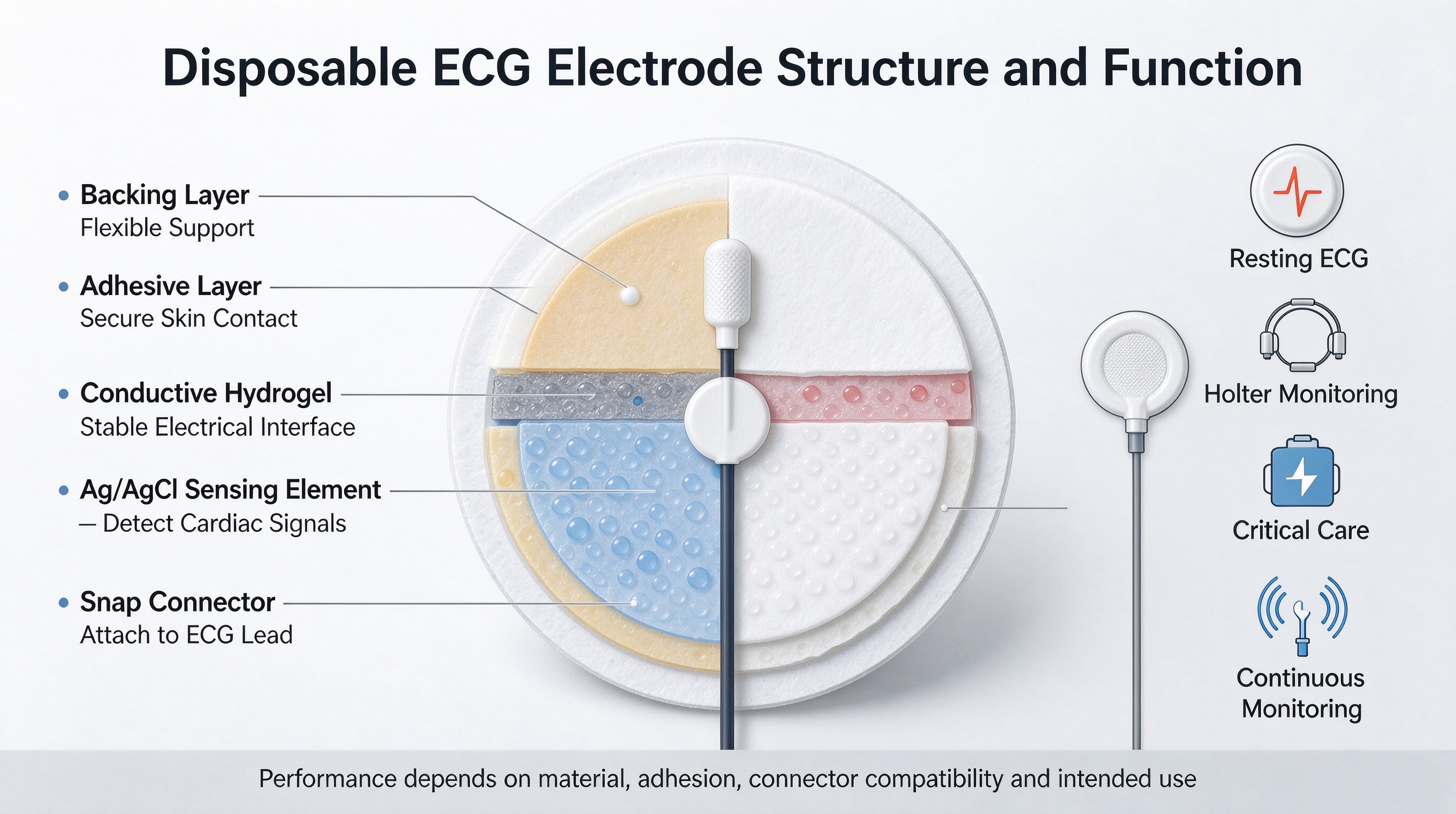
The material structure of a disposable ECG electrode directly affects electrical performance, skin contact, comfort, and manufacturing requirements.
Ag/AgCl electrodes are widely used in ECG applications because they provide a stable electrochemical interface for recording low-amplitude cardiac signals.
The conductive element works with an electrolyte medium to transfer ionic signals at the skin interface into electrical signals that the monitoring equipment can measure.
Electrode manufacturers must evaluate electrical stability, material consistency, and compatibility with the intended ECG device.
ECG electrode hydrogel provides electrical contact between the skin and the conductive sensing element.
The gel helps reduce electrode-skin impedance and supports stable signal transmission.
Important selection factors include:
Electrical conductivity and impedance.
Skin compatibility and moisture retention.
Adhesion during the intended recording period.
Gel stability throughout the product's labeled shelf life.
Hydrogel formulations should be selected and validated for their specific medical application.
The backing layer supports the electrode structure and helps maintain skin contact.
Foam ECG electrodes may provide cushioning and conformability, while non-woven ECG electrodes can offer a flexible, breathable backing depending on material design.
Backing Material | Main Characteristics | Common Considerations |
|---|---|---|
Foam | Soft, flexible, cushioning | Moisture resistance and adhesion |
Non-Woven Fabric | Lightweight and conformable | Breathability and skin comfort |
Film-Based Materials | Thin and flexible | Moisture barrier and adhesion design |
The most suitable backing material depends on the monitoring duration, patient conditions, and adhesive performance.
Disposable ECG electrodes typically use skin-contact adhesives to maintain their position throughout recording.
Common connection designs include snap connectors, tab-style interfaces, and electrodes with pre-attached lead wires.
Manufacturers should verify connector compatibility, attachment reliability, and safe electrical performance for the intended monitoring equipment.
A reliable medical ECG electrode should provide stable electrical contact while remaining comfortable and secure during the intended period of use.
ECG signals have relatively small amplitudes, making consistent electrical contact important.
Electrode materials and conductive gel formulations should help minimize excessive impedance, offset instability, and electrical noise.
The electrode should remain attached during the intended examination or monitoring period.
Adhesive performance is especially important when patients move, sweat, or require extended monitoring.
Materials in contact with the skin must be evaluated for the intended exposure conditions.
Electrode developers should consider irritation, sensitization, and material biocompatibility when selecting conductive gels and adhesives.
Connectors, lead wires, and electrode construction must be compatible with the intended ECG device.
For manufacturers, consistent dimensions and reliable connector performance are important considerations in product design.
The FDA's electrocardiograph electrode guidance identifies biocompatibility, electrical performance, adhesive performance, and shelf life as important evaluation areas.
Both disposable and reusable electrodes can be used for appropriate cardiac recording applications, but they differ in maintenance requirements and intended use.
Comparison | Disposable ECG Electrodes | Reusable ECG Electrodes |
|---|---|---|
Intended Use | Single-use | Multiple uses when approved |
Cleaning | No reprocessing for reuse | Cleaning or reprocessing required |
Electrode Interface | Often pre-gelled | Depends on electrode design |
Maintenance | Replace after use | Inspect and maintain |
Common Applications | Routine ECG and patient monitoring | Selected diagnostic and clinical applications |
Disposable electrodes are convenient for facilities requiring standardized single-patient use, while reusable designs may be appropriate where supported by validated cleaning procedures.
Disposable ECG electrode pads support a variety of cardiac monitoring and diagnostic procedures.
A standard 12-lead ECG uses ten physical electrodes to produce twelve electrical views of the heart.
Disposable electrodes are frequently used for limb and chest electrode placement during routine examinations.
For more information about chest lead positions, read our guide: What Does V1, V2, V3, V4, V5, V6 Mean on ECG?
Hospitals and healthcare facilities use ECG electrodes with compatible monitoring systems to continuously observe cardiac electrical activity.
Electrodes selected for longer monitoring periods should maintain reliable adhesion and electrical contact throughout their intended use.
Holter monitoring electrodes are used with portable recording equipment that monitors cardiac activity during normal daily routines.
These applications require attention to electrode stability, motion-related artifacts, skin compatibility, and monitoring duration.
Disposable ECG electrodes are used in emergency departments and critical care environments where cardiac signals must be recorded efficiently.
Product selection should consider device compatibility, application conditions, and the specific monitoring requirements.
Healthcare buyers and medical device manufacturers should evaluate product performance according to the intended application rather than selecting electrodes based only on price.
Short resting ECG examinations and extended ambulatory monitoring place different demands on electrode adhesion, gel stability, and skin comfort.
Electrical characteristics such as impedance, DC offset voltage, noise, and defibrillation overload recovery may be relevant to product evaluation.
The ANSI/AAMI EC12 standard addresses labeling, safety, and performance requirements for disposable ECG electrodes.
Skin-contact materials should undergo appropriate biocompatibility evaluation for their intended contact type and duration.
Buyers should request relevant test information and product documentation from suppliers.
Medical device manufacturers may require specific electrode shapes, backing materials, adhesive properties, conductive interfaces, or connector configurations.
Customization should be supported by suitable material testing and product validation.
Material selection is an important part of electrode development. Conductive materials must provide suitable electrical properties while meeting the mechanical and environmental requirements of the intended device.
Although disposable diagnostic ECG electrodes commonly use Ag/AgCl-based sensing elements and conductive gels, other electrode technologies may incorporate conductive silicone, conductive rubber, or specialized contact materials.
These materials are used across different wearable, stimulation, and medical-device applications. However, their suitability for ECG sensing requires application-specific evaluation.
At Jinke Rubber, our product range includes electrode pads and conductive silicone products for compatible TENS/EMS and other intended applications.
Medical device manufacturers developing new electrode components should assess material conductivity, dimensions, connector design, and validation requirements before selecting a solution.
Even correctly designed ECG electrodes can experience performance issues when applied improperly or used outside their intended conditions.
Common Problem | Possible Cause | Recommended Consideration |
|---|---|---|
Noisy ECG Signal | Poor skin contact or movement | Check placement and adhesion |
Electrode Detachment | Inadequate adhesion | Select suitable adhesive design |
Skin Irritation | Material sensitivity or prolonged contact | Evaluate compatibility and intended duration |
Unstable Recording | Gel deterioration or poor contact | Check storage conditions and product integrity |
Connection Problems | Incompatible or loose connector | Verify lead-wire compatibility |
Following manufacturer instructions for application, storage, and replacement helps maintain reliable recording performance.
Disposable ECG electrodes play an important role in cardiac diagnostic and monitoring applications.
Their performance depends on appropriate conductive materials, stable skin contact, reliable adhesion, connector compatibility, and product safety.
For healthcare buyers and medical device manufacturers, selecting suitable electrodes requires evaluating both electrical performance and intended clinical use.
At Jinke Rubber, we focus on conductive materials and electrode components for compatible medical-device and electrotherapy applications. Contact our team to discuss conductive silicone materials, electrode designs, and OEM/ODM development requirements.
They commonly contain an Ag/AgCl sensing element, conductive gel or hydrogel, an adhesive backing, and a connector for ECG equipment.
Foam provides a cushioning backing, while non-woven materials may offer flexibility and breathability. Performance depends on the complete electrode design, including its adhesive and conductive interface.
The appropriate wear time depends on the product's labeled intended use and monitoring application. Follow the manufacturer's instructions.
Yes, products specifically designed and labeled for compatible Holter monitoring applications can be used. Adhesion and signal stability should be evaluated for the intended monitoring period.
No. Single-use ECG electrodes should not be reused because reuse may compromise adhesion, electrical performance, and hygiene.
No. ECG electrodes record electrical activity, while TENS electrodes deliver electrical stimulation. Their intended uses and performance requirements differ.


